Africa will have 450 million children to teach.It is already short 15 million teachers.
A private tutor costs $15–40 an hour, so families ration them to four hours a month. We watch the page instead — every evening, for about $12 a month — and prove each step by symbolic computation rather than handing over an answer nobody can check.
- +170 M
- more school-age children by 2050
- 280 M in 2020 → about 450 M
- 15 M
- teachers missing by 2030
- UNESCO — Sub-Saharan Africa
- 10.7 M
- of that gap is secondary school
- exactly where we work
- $22 B
- already spent on private tutoring
- Middle East & Africa, 2024
How it works
It watches the reasoning, not the answer
Every assessment ever built looks at what a student produced. This looks at how — line by line, while the pen is still moving. The student works on paper exactly as they would anyway; the difference is that the moment a step stops following from the one above it, something notices — and writes it down.
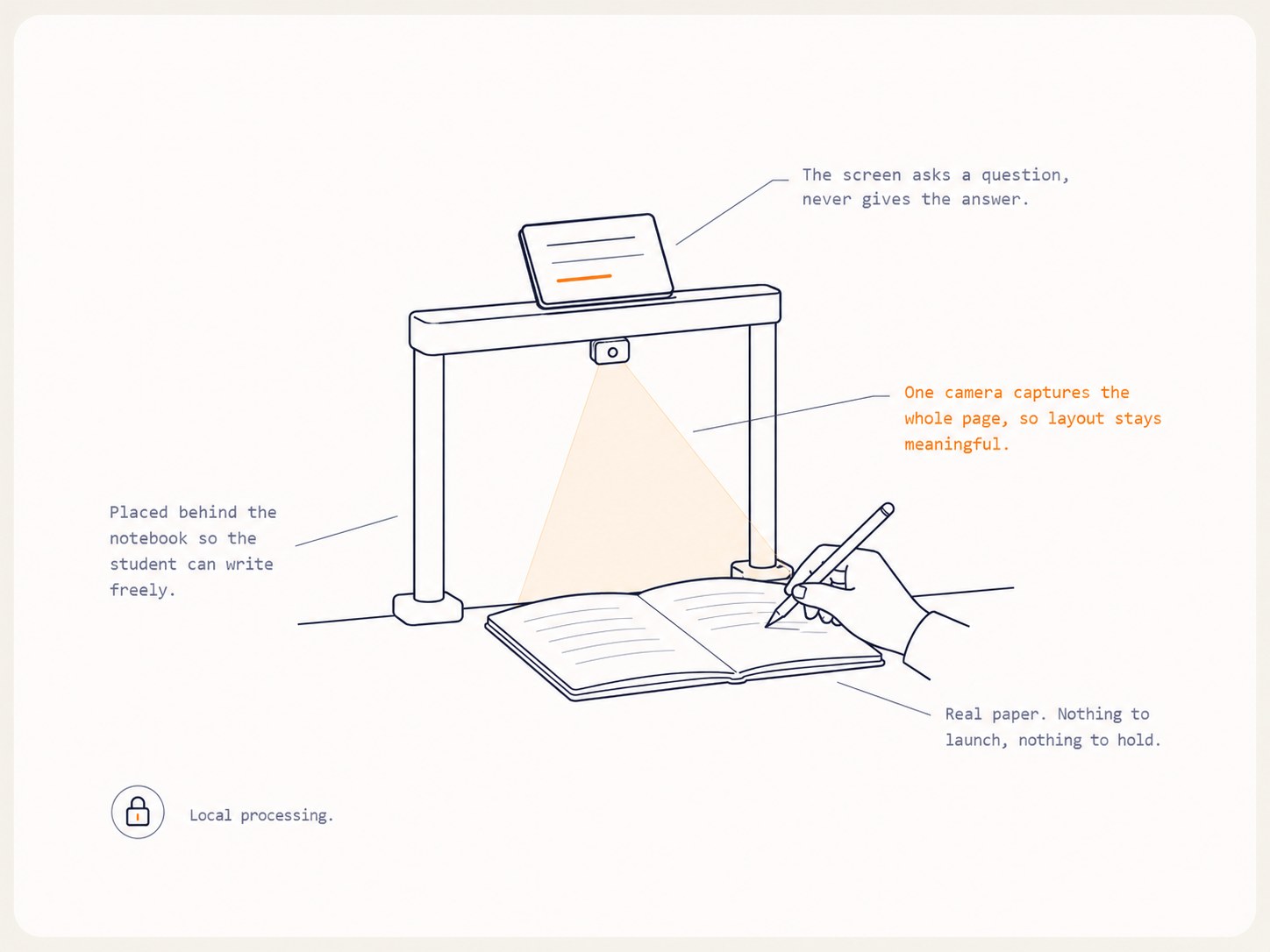
- —One camera captures the whole page, so layout stays meaningful.
- —The screen asks a question, never gives the answer.
- —Placed behind the notebook so the student can write freely.
- —Local processing.
The pipeline, stage by stage
Photo in, one question out.
Stage four is the one that compounds. Everything before it establishes what is true by computation, and the model at the end only decides what to say about it. But in between, the session is written down — and that log is the thing nobody else has. Every assessment ever built records what a student answered. This records how they got there: where they hesitated, what they crossed out, which wrong rule they keep reaching for.
- 01
Capture
Phone or browser
A frame every few seconds. No video, no stream — just the page as it stands.
- 02
Detect what changed
Browser, on device
Each frame is compared to the last. Hand across the page: wait. Nothing new: do nothing. A region that has stopped moving: crop it. Almost everything is thrown away here.
- 03
Read the crop
Local OCR
Only the crop is read, never the page. One handwritten line costs a fraction of what a full page would — which is what makes watching continuously affordable at all.
- 04
Record
The student log
The line joins a timestamped log of the session: what was written and when, how long the pen paused, what was crossed out and rewritten, which mistakes keep coming back week after week.
- 05
Diagnose
Backend
Each line is checked against the one above it for equivalence. The first line that breaks is identified, and the library names the wrong rule that regenerates it exactly.
- 06
Ask
Frontier model
Once the maths is settled, a model words the question — weighing what this student has got wrong before, and whether this is even the moment to interrupt.
Verification in time
A wrong step corrected on Thursday was practised all week
Marking is retrospective by construction. Ours is not: the check runs on every line as it is written, which is the only moment at which the student still remembers what they were thinking.
The line follows
Say nothing
The hardest thing for anyone helping is to stay quiet while a student is thinking. Software is good at it.
The line does not follow
Catch it now
The error is caught on the line where it happens, not on a paper returned three days later. By then the student has practised it four more times.
The student stalls
Offer the next question
A pen that has not moved is a signal. They can also simply say so — but they should not have to.
Why an assistant is not a teacher
Ask an assistant and it answers. The student has learned nothing.
It is like a teacher who steps out of the room at every exercise and comes back having written the answer on the board. The part that got skipped — the struggle, the wrong turn, the correction — is the part where learning actually happens. And because the answer arrives finished, the student has no way to notice the times it is wrong.
So we never give the answer. When a step breaks, the student gets one question, aimed at the belief that produced the error — because we know which belief it was, having reproduced it.
What the student wrote
(a + b)² = a² + b²What the screen shows
« Expand (a + b)(a + b) by hand, term by term. How many terms do you get? »
Not « you forgot the cross term ». The student who counts four terms and finds two of them equal has learned something the correction would have denied them.
And when the library cannot account for an error, it says so rather than inventing a plausible story. A system that never admits ignorance cannot be trusted by someone who is not equipped to check it — which describes every student working alone.
The device
It stands at the head of the notebook
Nothing to hold, nothing to launch, no phone of the student's to depend on. Camera, light and screen in one arch that watches the page continuously — so an error is caught the second it is written rather than ten minutes later. The screen answers with a question, and the session is written down as it happens.
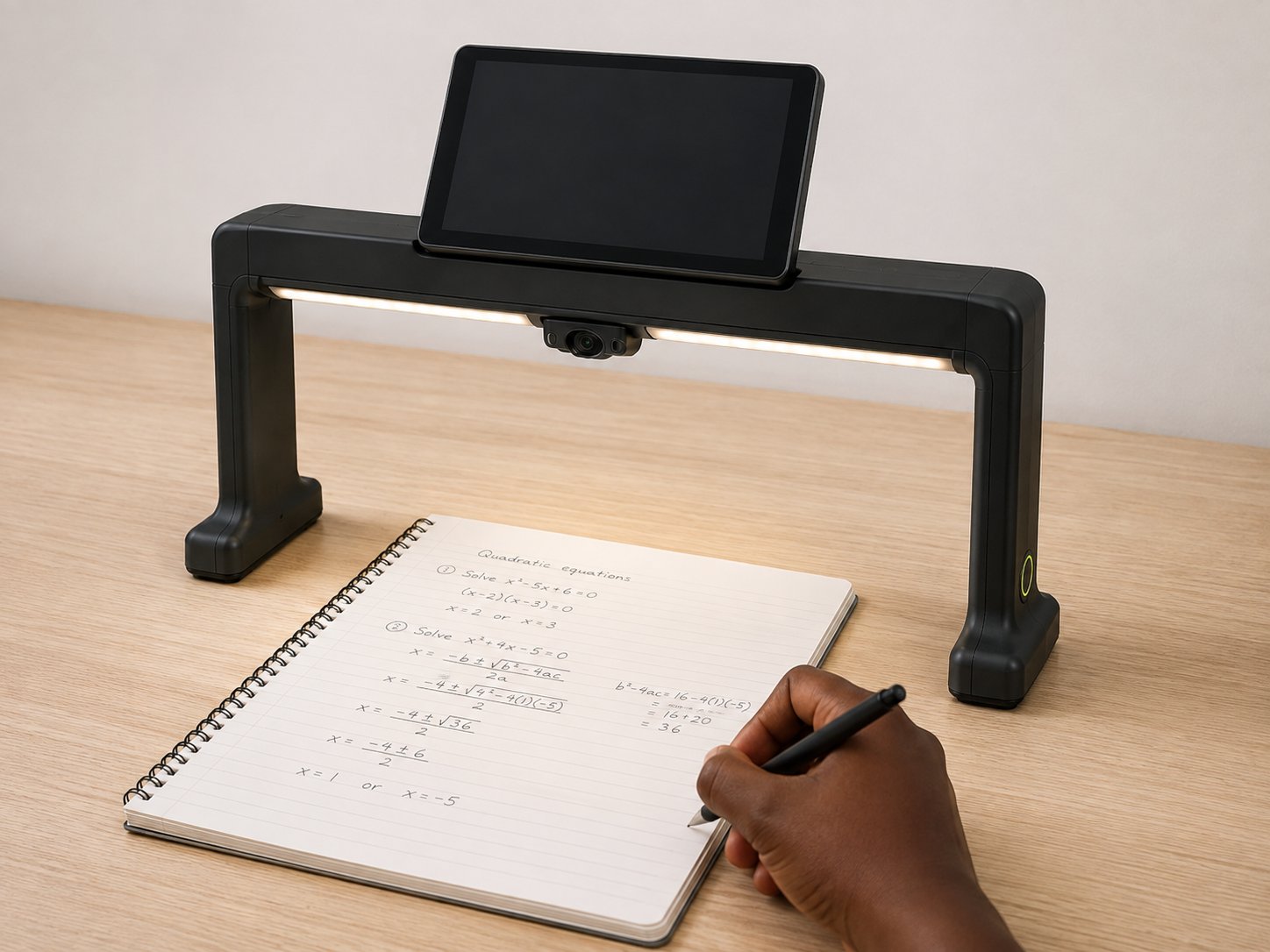
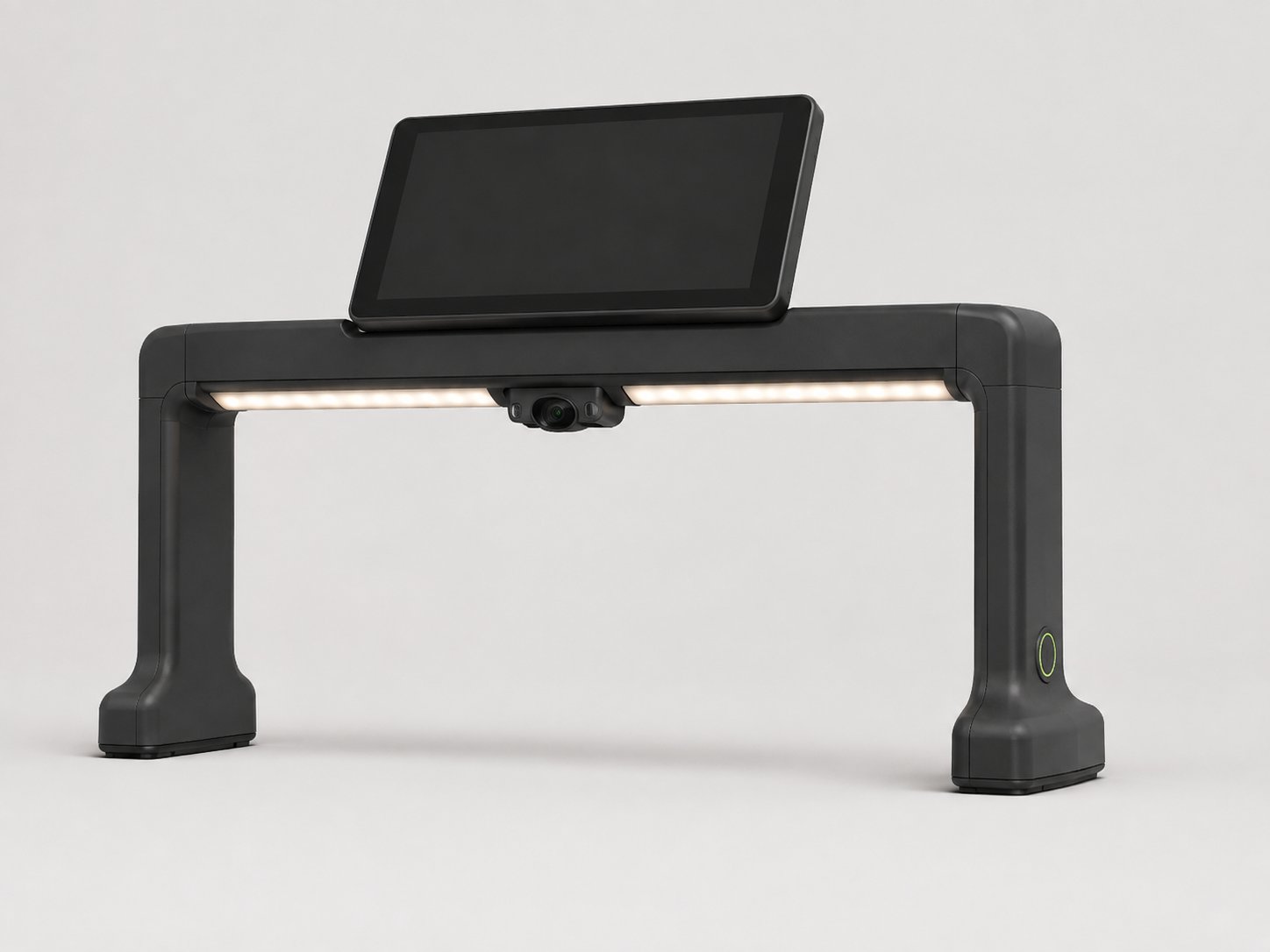
One camera, high enough and set back far enough to hold a whole page at once. That matters more than it sounds: in mathematics the position of a symbol carries its meaning — an exponent is only an exponent because of where it sits. A sensor that follows the pen would read the strokes and lose the layout, which is why this watches the page instead.
The light is part of the instrument, not a comfort. Without it, a desk lamp throws the writing hand's shadow straight across the working area and half the captures are unusable.
And the screen faces the student rather than a parent or a teacher. It sits just above the page, so the eye moves from notebook to question without lifting the head.
Where the model is today
First-pass mesh · not CAD
The business
We start where we can get paid, to get where we have to go
Our first customers are not the families in the 15-million-teacher statistic. They are English-medium IB and IGCSE households in Nairobi, Dar es Salaam, Kigali, Lagos and Accra — who pay in hard currency, share a time zone with European tutors, and already buy private tutoring at $15–40 an hour. That budget funds the descent down-market; it is the entry point, not the destination. Every device sold amortises the engine, and every hour taught grows the library — until the marginal cost of a good correction approaches zero and families who could never pay become servable.
The demand is not hypothetical
- $22 B
- Private tutoring across the Middle East and Africa in 2024
- Forecast to reach roughly $41 B by 2032. Families are already paying — the market exists, it is simply priced for the few.
- Over half
- Of Kenyan students already take private tutoring
- Over 90% in Egypt and Ghana. We are not persuading anyone to start; we are changing what an hour costs.
- 10.7 M
- Of the teacher shortfall is secondary education
- Against 4.4 M for primary. The gap is worst precisely in the maths and science years we serve.
Teacher shortfall: UNESCO Global Report on Teachers. Tutoring market: Middle East & Africa private tutoring, StellarMR 2025. Participation rates: Bray, Shadow Education in Africa, 2021.
Why this could not have been built ten years ago
The wave is already born
The children who take Sub-Saharan Africa from 280 to roughly 450 million school-age kids are alive today. This is demography, not a forecast — and the teacher shortfall is dated 2030.
The object finally costs about $70
A camera module and a small computer put a device that watches paper inside a household budget. The same build was an order of magnitude more a decade ago.
Machines only just learned to read handwriting
Reliable transcription of messy handwritten maths is roughly two years old. It is the one stage we could not have built ourselves at any price.
The market, and our share of arithmetic
One chart is published research. One is our own unit model.
US$ billions. One measured point; the curve is the reported 8.2% growth rate.
At 3 learners per arch and $12/learner/month. Fleet size on a log axis.
Plotted against fleet size, not against time — we can defend what a deployed unit earns; we cannot yet defend a date. The pilot is 15 arches.
Why hardware does not sink us
A device on a single subscription takes 8.1 months to repay itself, which is not a business. So we price a learner, not a box. The camera does not care how many notebooks pass under it — siblings and study groups share one arch, and payback drops to 2.6 months. Sharing is not a loophole in the model; it is the model, and it is what makes the access real rather than rhetorical.
Every figure on the right-hand chart is arithmetic on that unit model, not a forecast. The input we are least sure of is the local hourly tutoring rate, and replacing it with numbers from live interviews in Nairobi is work in progress.
Why here first
The place with the least teaching capacity is the place worth solving
A tutoring product built for a market with enough teachers is a convenience. Built where the shortfall is 15 million people, the same product is infrastructure — and the constraint forces a discipline that a comfortable market never would: it has to work without a reliable teacher in the room, without a laptop per child, and at a price a household can carry.
Nothing about the method is specific to Africa. A wrong rule for expanding a square is wrong in Lagos, Lyon and Ohio, and every education system on earth is short of maths teachers. But a product that survives the hardest constraints travels outward easily, and one built for the easiest market never travels inward at all. So the order matters: here first, then everywhere.
And a model trained on how African students actually learn belongs, in the end, to African schools. Kenya's data protection law applies to us from the first unit — we would rather build to it now than be corrected later.
What compounds
The camera is the wedge. The record is the company.
The record
Measures the work, not just the answer
Hesitation before a step. Lines crossed out and rewritten. The hour at which accuracy collapses. Every assessment ever built records what a student produced; this records how — and that data exists at scale for no population anywhere.
The compounding
Each hour observed is an hour nobody pays for
The library of named errors grows from every paper it cannot yet explain. As it covers more, the engine handles more alone, and human hours move to what software will not do — motivation and accountability.
On holding a record of a child
Video is processed on the device and never leaves it — only the line that changed is analysed. A hardware indicator shows when the camera is live and a physical switch cuts its power. Kenya's data protection law applies to us from the first unit, and a model trained on African students belongs in African schools.
Who is building this
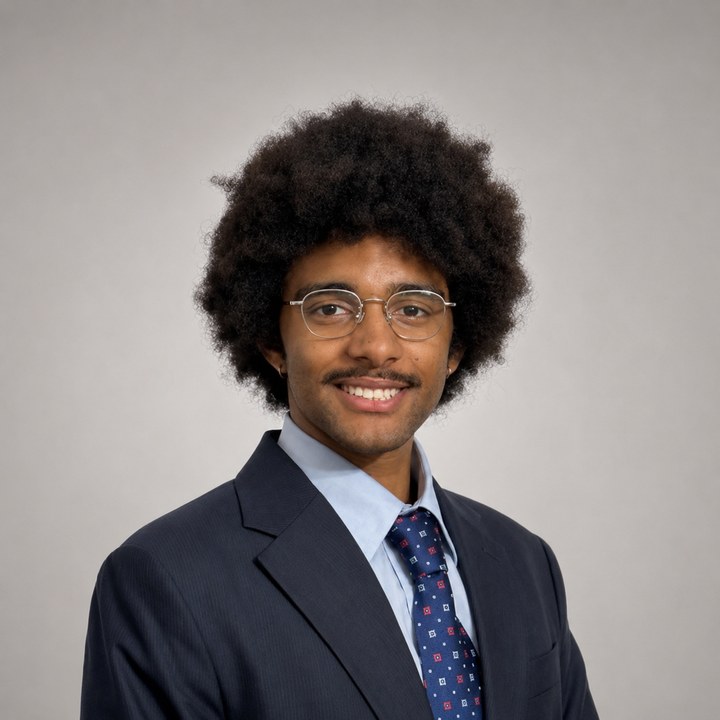
Clément Duméril
Mechanical engineering, Arts et Métiers (ENSAM) · MEng, UC Berkeley
I sit on both sides of this problem. The supply side of the network — European engineering students who can teach STEM — is the one I come from and can recruit directly. The hardware is what I was trained to design. And this is not a plan: the diagnostic engine below is written, running and measured.
Stated plainly rather than left to be found: I am a solo founder, working on this part-time until my MEng finishes in May 2027, and full-time from then. Burn to date is about zero. I am looking for a technical co-founder at Berkeley.